





What it owns
Tiny pieces of Apple, Microsoft, NVIDIA, Amazon, Google, and 513 other big US companies.
Top 10 holdings = ~36% of the fund
Plain-English explainers
How to buy, when to buy, what to do when it dips, and how taxes work. Reference reading you can come back to.
All guidesFirst moves
Build a plan
0/9 read
Four questions, four answers. If you read nothing else on this page, read these.
Tiny pieces of Apple, Microsoft, NVIDIA, Amazon, Google, and 513 other big US companies.
0.03% per year. On a $10,000 investment, that's $3 a year. On $100,000, it's $30 a year.
Two ways: the share price goes up as the companies inside grow, and you receive cash dividends every 3 months.
Vanguard, founded in 1975 and owned by its own fund investors, manages roughly $9 trillion globally.
When you buy a share, you own a slice of each of these. The biggest companies have the biggest slice.
The top 10 account for about 36% of VOO. The other ~508 companies make up the remaining 64%. This is called market-cap weighting: bigger companies get bigger weight. See which 10 companies drive that 36% →
Technology is roughly a third of the fund. That's because the biggest US companies right now are tech companies. VOO follows the market; it doesn't overweight any sector on purpose.
Annualized total returns through early 2026, assuming dividends were reinvested. These are backward-looking. Future returns will be different.
Not every year is a winner. VOO fell about 18% in 2022 and ~37% during the 2008 crash (via the index it tracks). The average masks a bumpy ride. Source: Vanguard, Yahoo Finance, monthly close data at voo-monthly.json.
Assuming a 10% annual return (the long-term S&P 500 average, before inflation). Pick an amount and a timeframe.
This is an illustration using a fixed 10% annual return. Real returns vary year to year. Not investment advice.
0.03% a year. Over 30 years, the gap between a 0.03% fund and a 1% fund on $100,000 is roughly $200,000 in lost growth. Fees compound too, in the wrong direction.
You own pieces of 500 companies across 11 sectors. If one company blows up, you barely notice. You don't need to pick winners. You own them all.
ETFs rarely distribute capital gains. VOO's structure (a share class of Vanguard's main 500 Index Fund) makes it one of the most tax-efficient S&P 500 funds you can own in a regular (taxable) brokerage account.
Every investment has trade-offs. Here are VOO's main ones.
The 10 biggest companies make up ~36% of VOO. Most of those are tech. If big tech has a bad stretch, VOO feels it. Read why VOO's tech concentration matters, or see how much of your money is in those 10 stocks →
Every company in VOO is a US company. You get zero exposure to Europe, Asia, or emerging markets. If the US stock market underperforms the rest of the world for a decade (it has happened before), VOO alone won't capture that.
VOO fell about 18% in 2022, ~34% briefly in early 2020, and the S&P 500 fell ~37% in 2008. Diversification doesn't protect you when the whole market drops. Only invest money you won't need for 5+ years.
How does VOO stack up against the other big S&P 500 and US stock funds? Click a comparison.
Step-by-step: pick a broker, place your first buy, set up automatic investing.
Read →Why most people should buy VOO on a schedule, not in a single lump sum.
Read →The top 10 holdings are 36% of the fund. How much risk does that really add?
Read →DRIP versus cash — how much extra a reinvested $10K becomes over 15 years.
Read →The minimalist strategy: buy VOO, add to it automatically, don't look too often.
Read →Why VOO is one of the most-held funds inside Roth IRAs, and how to buy it there.
Read →Dividends, capital gains, qualified rates, and why ETFs are tax-efficient.
Read →Non-US investor? Here's what you can buy, and the UCITS alternatives to consider.
Read →Every guide on the site.
Browse →For most beginners, yes. You get instant diversification across 500 large US companies, pay only 0.03% a year in fees, and don't need to pick individual stocks. It still carries full stock-market risk (it can drop 15-30% in a bear market), so only invest money you don't need for at least 5 years.
Almost. The S&P 500 is a list of ~500 large US companies published by S&P Global. VOO is a fund that buys and holds those exact stocks in the same proportions. So owning VOO is the easiest way to own the S&P 500. VOO's return will trail the index by about 0.03% a year because of its fee.
At today's share price you'd need a few hundred dollars to buy one full share. But most major brokers (Fidelity, Schwab, Robinhood, and Vanguard itself) now support fractional shares, so you can invest any dollar amount, even $1. Interactive Brokers and a few legacy brokerages don't.
Yes. VOO pays a cash dividend every 3 months, in March, June, September, and December. The current yield is about 1.2%, which works out to roughly $7–$8 per share per year. You can either receive the cash or reinvest it automatically with most brokers (set DRIP in your account settings).
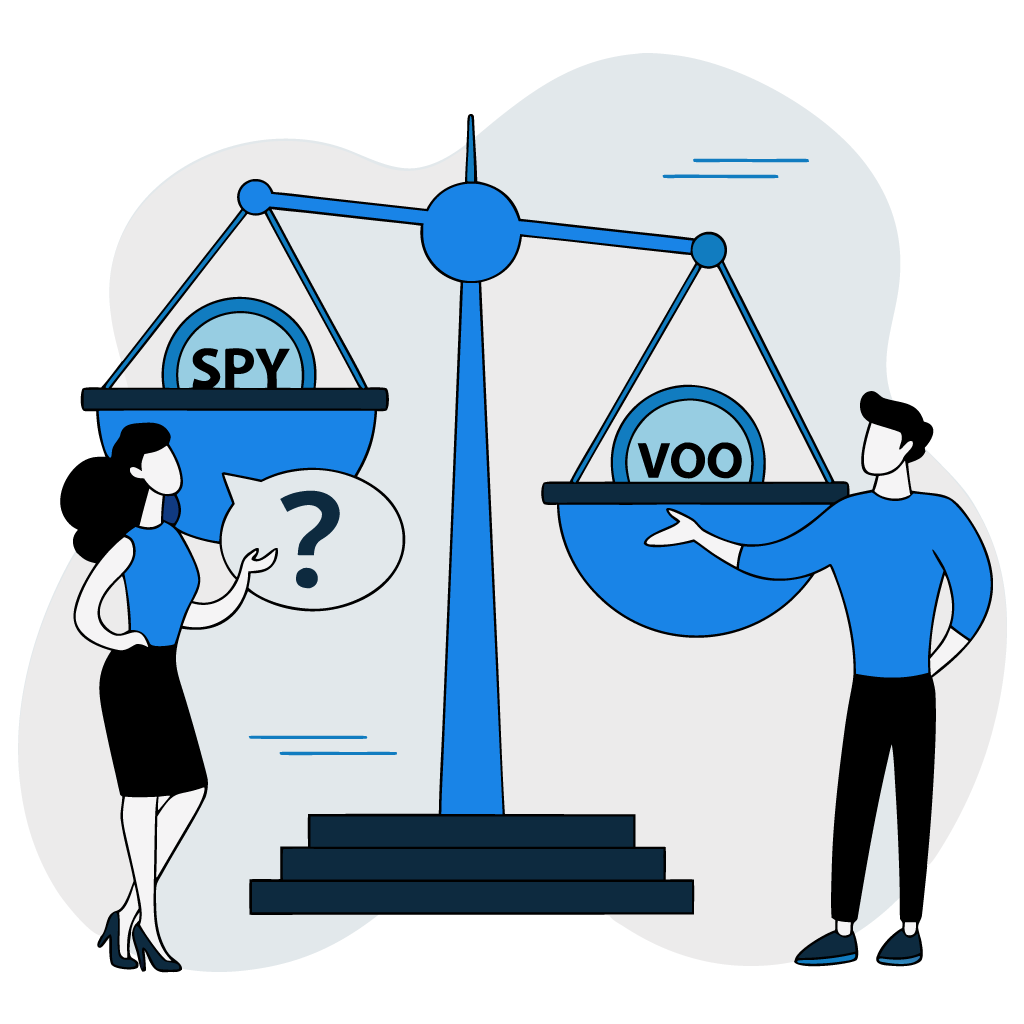
Both track the S&P 500. VOO charges 0.03% a year, SPY charges 0.09%. For a long-term buy-and-hold investor, VOO is cheaper and usually the better pick. SPY trades more actively and has a deeper options market, so day traders and institutions often prefer it. See our full VOO vs SPY comparison for the details.
VOO can absolutely lose money. It fell 18.2% in 2022, ~34% briefly in early 2020, and ~37% in 2008. It's diversified across 500 companies, so no single business going bankrupt can wipe you out. But when the broad US market drops, VOO drops with it. Over rolling 10-year periods it has historically recovered, but there are no guarantees.
Yes, and it's one of the most popular holdings in both. Inside a Roth IRA, all future growth and withdrawals (after age 59½) are tax-free. Inside a 401(k) or traditional IRA, growth is tax-deferred until you withdraw. Since VOO is already very tax-efficient, the benefit of sheltering it is largest inside a Roth.
Since VOO launched in September 2010, it has returned roughly 14% per year on average (through early 2026), helped by an unusually strong bull market. The S&P 500's very long-term historical average, going back to 1957, is closer to 10% per year before inflation. Use the 10% figure for planning purposes; the recent 14% is unlikely to continue forever.