








0.0945%
$580B AUM · deepest liquidity
Plain-English explainers
How to buy, when to buy, what to do when it dips, and how taxes work. Reference reading you can come back to.
All guidesFirst moves
Build a plan
0/9 read
Best if you’re saving for retirement, DCA-ing monthly, or parking cash in a tax-advantaged account.
Tied at 0.03%. Open-end ETF structure. On a $100k balance over 30 years, you keep about $6,500 more than in SPY.
Best if you write covered calls, buy options, day-trade the S&P, or run institutional block trades.
Largest options market of any equity on Earth. Tighter intraday spreads than VOO or IVV. The 0.0945% fee is the price of that liquidity.
| SPY SPDR S&P 500 | VOO Vanguard S&P 500 | IVV iShares Core S&P 500 | |
|---|---|---|---|
| Expense ratio | 0.0945% | 0.03% | 0.03% |
| Annual cost per $10k | $9.45 | $3.00 | $3.00 |
| Assets (AUM) | ~$580B | ~$1.51T | ~$600B |
| Structure | UIT | Open-end ETF | Open-end ETF |
| Internal dividend reinvestment | No (cash drag) | Yes | Yes |
| Average daily volume | ~75M shares | ~5M shares | ~5M shares |
| Options market | Deepest of any equity | Liquid but thinner | Liquid but thinner |
| Inception | Jan 22, 1993 | Sep 7, 2010 | May 19, 2000 |
| Dividend schedule | Quarterly | Quarterly | Quarterly |
| Issuer | State Street | Vanguard | BlackRock |
Data as of Apr 22, 2026. Winner highlighted per row where meaningful. Sources: Vanguard, State Street, BlackRock, Morningstar, Yahoo Finance.
Annual fee per $10,000 invested.
VOO and IVV at 0.03% are tied for cheapest. SPY at 0.0945% is about 3x more expensive. Over 30 years on $100k at 8%, SPY's extra drag costs roughly $6,500.
SPY's unit-investment-trust structure can't reinvest dividends between pay dates, so a small cash balance sits idle when the market is rising. VOO and IVV reinvest immediately. The real-world gap is a few basis points per year.
SPY trades ~75M shares per day; VOO and IVV trade closer to 5M. More importantly, SPY has the largest options market of any equity on Earth. For retail buy-and-hold this is invisible. For options writers, block traders, and institutions, it's the whole ball game.
All three track the S&P 500 to within a few basis points per year. Over 15-year rolling windows, VOO and IVV have slightly outperformed SPY by roughly the fee differential (~0.06% per year). Over any single year, the winner can be any of the three.
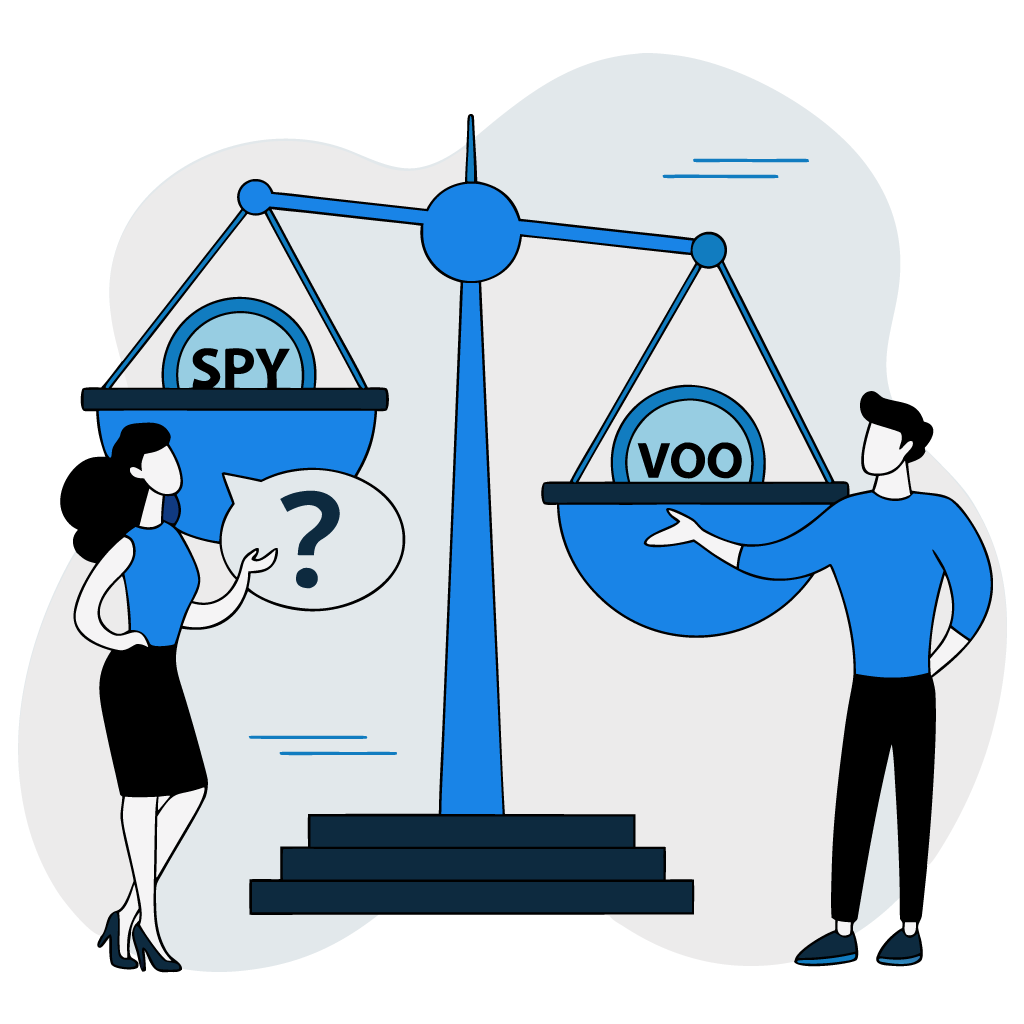
For long-term buy-and-hold, VOO or IVV — both charge 0.03% and are essentially interchangeable. For options and institutional trading, SPY — its 0.0945% fee is the toll for owning the deepest options market in the world. For a Roth IRA or 401(k), VOO or IVV every time. See our VOO vs SPY and VOO vs IVV breakdowns.
All three track the same S&P 500 index with essentially identical holdings. Differences: SPY is a UIT (1993, State Street, 0.0945%); VOO is an open-end ETF (2010, Vanguard, 0.03%); IVV is an open-end ETF (2000, BlackRock, 0.03%). SPY has ~75M shares/day volume; VOO and IVV closer to 5M.
SPY's older UIT structure has more operational overhead. State Street hasn't cut SPY's fee aggressively because SPY's institutional and options-market revenue makes it profitable at 0.0945%. The premium is justified for traders who value its liquidity; not for long-term retail holders.
Close, not identical. All three distribute quarterly from the same underlying S&P 500 constituents. VOO and IVV yields are effectively tied at the same fee. SPY's yield runs about 0.06 percentage points lower because of its higher expense ratio, plus a small cash-drag effect from its UIT structure.
VOO or IVV. In tax-advantaged accounts there's no tax-efficiency edge for any of the three, so the decision reduces to fee. The $6,500 gap on a $100k, 30-year balance is real. Pick what your broker offers; if both, flip a coin.