







In one sentence
Buy VOO — one fund holding the 500 biggest US companies — on a regular schedule, reinvest the dividends, and never sell.
That's it. No stock picking, no market timing, no checking prices at 2 AM. The name is a play on "Netflix and Chill" because the whole point is that investing should be boring.
See how much you could make →$10,000 invested in VOO in late 2010
~$62,000
by early 2026 — through two bear markets, a pandemic, and an inflation spike
Calculate your own number →How to start in 15 minutes
- Open a brokerage account at Fidelity, Schwab, or Vanguard (free).
- Pick the account type — Roth IRA if you qualify, otherwise a regular brokerage account.
- Set up automatic recurring buys of VOO matching your paycheck. $25/week is fine.
- Turn on dividend reinvestment (DRIP) — it's a free toggle in your account settings.
- Do nothing. Don't check daily. Don't panic-sell. This is the hardest part.
That's the whole strategy. The rest of this page explains why it works, what happens in a crash, and the mistakes that trip people up — but if you only have two minutes, the four blocks above are everything that matters.
OK but what is VOO exactly?
VOO is a fund you can buy like a stock. It's called an ETF (exchange-traded fund), which is just a fancy name for a basket of stocks bundled together. When you buy one share of VOO, you're buying a tiny slice of about 500 companies at once.
These aren't random companies. They're the 500 biggest public companies in the US, known as the S&P 500. Think Apple, Microsoft, Amazon, Google, Tesla, JPMorgan, Visa — the companies that make up a huge part of the American economy. You can see the full list here.
The best part? It's almost free. VOO charges 0.03% per year. That's $3 for every $10,000 you invest. Compare that to paying a financial advisor 1%, which would be $100 on the same amount.
VOO at a Glance
500 biggest US companies
0.03% ($3 per $10K)
Vanguard
Why do people pick VOO over other funds?
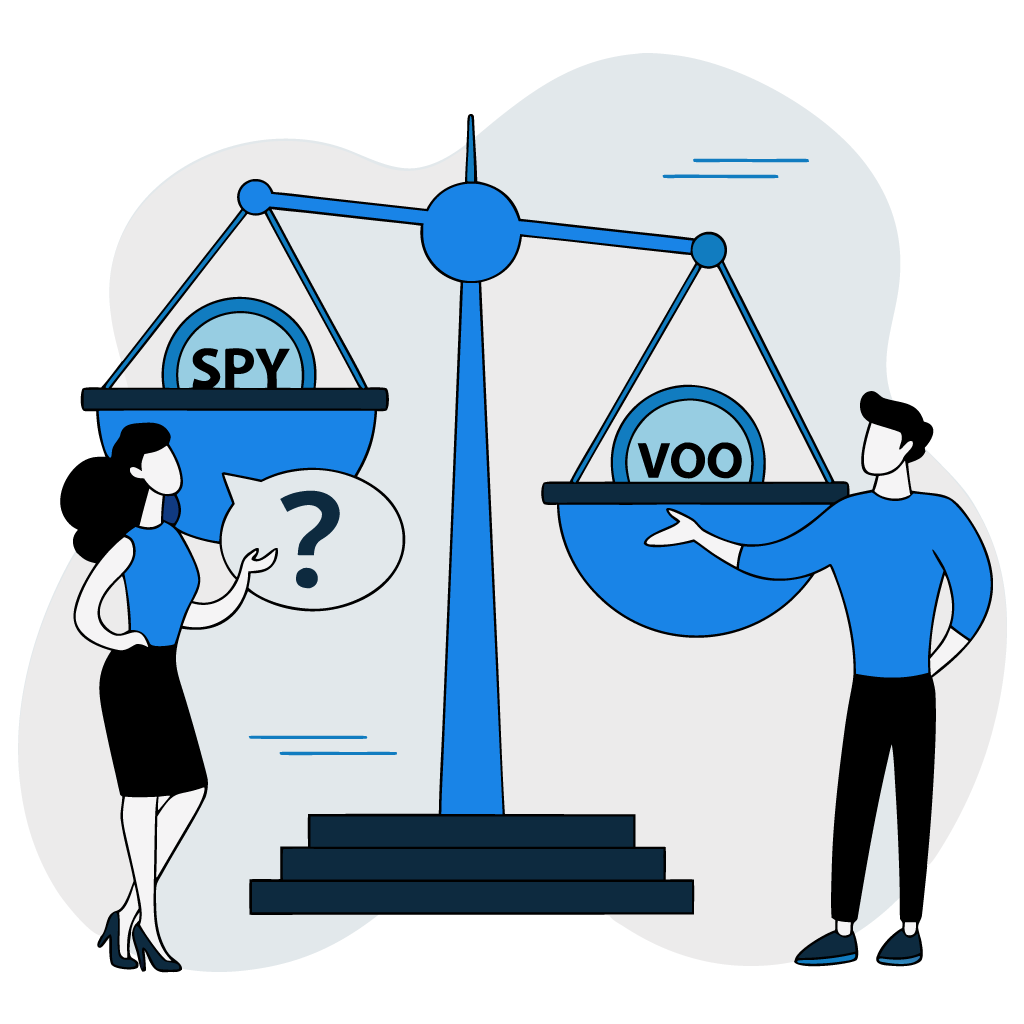
There are other funds that track the same 500 companies. SPY is the oldest one, and VTI covers even more stocks. So why VOO specifically?
It's one of the cheapest. VOO charges 0.03%. SPY charges 0.0945% — over three times more. That might sound tiny, but on $100,000 growing for 30 years, the cheaper fund saves you roughly $30,000. Small fees add up when you let them compound.
Vanguard's structure is unique. Unlike most fund companies, Vanguard is actually owned by the people who invest in their funds. There are no outside shareholders pushing for higher fees. It's like a credit union for investing.
It cleans itself up. If a company in the S&P 500 gets too small or goes bankrupt, it gets kicked out and replaced. You never have to do anything. The fund automatically adjusts. It's like a self-watering plant.
What happens when the market crashes?
This is the part that scares people. And it should be talked about honestly, because the market will crash while you're invested. The question isn't "if" but "when."
The good news? Every single crash in VOO's history has been temporary. Here's what happened to people who just held on:
COVID Crash · 2020
VOO dropped -19.9% from December 2019 to March 2020.
People who held? VOO was back to its old price by July 2020 — just 4 months later. By August it was hitting new highs.
2022 Bear Market
VOO dropped -18.7% from December 2021 to October 2022. This was a slow, painful grind — not a quick crash.
Recovery took longer: about 2 years. But by January 2026, VOO was at $636 — a 79% gain from the bottom.
The pattern: The market drops, people panic, and then it recovers. Every time. The people who lost money are the ones who sold during the drop. The people who did nothing came out ahead. Use the past performance calculator to check any time period yourself.
How to set up VOO and Chill (15 minutes)
This isn't complicated. You can do the whole thing from your phone. Here are the five steps:
Open a brokerage account
A brokerage account is where you buy and hold investments. Think of it like a bank account, but for stocks and ETFs. Fidelity, Schwab, and Vanguard are the most popular choices. All are free to open and let you buy VOO with no trading fees.
Pick your account type
Roth IRA is the best option for most people if you qualify — your money grows tax-free forever. If your job offers a 401(k) with an S&P 500 option, that works too. Otherwise, a regular brokerage account is perfectly fine.
Set up automatic purchases
Most brokers let you schedule recurring buys. Set it to buy a fixed dollar amount of VOO every week, every two weeks, or every month — whatever matches your paycheck. The amount doesn't matter as much as doing it consistently. Even $25 a week adds up.
Turn on dividend reinvestment (DRIP)
VOO pays you a small amount of cash every 3 months (called a dividend). DRIP automatically uses that cash to buy more VOO instead of leaving it sitting there. It's a free setting in your brokerage account. Turn it on and forget about it.
Do nothing (seriously)
This is the hardest step. Don't check your account every day. Don't sell when you see a scary headline. Don't try to "buy the dip." Your automatic purchases and DRIP are doing all the work. Check in once a quarter if you want, but honestly, once a year is fine.
The 4 mistakes that ruin VOO and Chill
The strategy is simple. Sticking to it is the hard part. Almost everyone who fails at VOO and Chill does one of these four things:
1. Panic selling when the market drops. When VOO fell 19.9% in March 2020, a lot of people sold everything. Those people locked in their losses and missed the recovery that started almost immediately. If you sell during a crash, you need to get two decisions right: when to sell and when to buy back in. Even professional fund managers can't do that consistently.
2. Checking the account too often. On any given day, there's roughly a 50/50 chance your account is down. That's just how markets work day to day. But over a decade, those daily drops are invisible. If you check every day, you'll feel anxious for no reason. Check once a quarter at most.
3. Switching to whatever's hot. When tech stocks are booming, QQQ looks better. When dividend stocks are hot, SCHD looks tempting. Chasing whatever performed best last year is the opposite of "chill." Pick your strategy and stick with it.
4. Waiting for the "perfect" time to start. People who waited for VOO to drop below $400 after it hit that price in 2021 are still waiting — it went to $636 by early 2026. The best time to start is now. The second best time is also now.
Is this strategy right for you?
VOO and Chill is great if you:
Have 10+ years before you need the money. Want a simple, set-it-and-forget-it approach. Don't want to spend time picking stocks or watching markets. Are in your 20s, 30s, or 40s building long-term wealth.
VOO and Chill might NOT be right if you:
Need the money within 5 years (for a house, a wedding, etc.). Are retired and need regular income to live on — VOO only pays about 1.2% in dividends, which isn't enough. Want exposure to companies outside the US — VOO only holds American stocks. Want a more diversified mix — VTI covers more of the market if you want smaller companies too.
The bottom line
VOO and Chill works because it removes the two things that hurt most investors: high fees and bad decisions. You pay almost nothing in fees (0.03%), and the automatic setup removes your ability to make emotional mistakes.
It won't make you rich overnight. It won't impress anyone at a party. But $10,000 invested in VOO in 2010 turned into roughly $62,000 by 2026 — and the people who earned that return did exactly one thing: nothing. They held.